
The Process of Process: Piloting GROUNDWORK: Interdisciplinary Cultivation Unit at Rutgers University
Jan 13, 2026
by Rita Leduc
INTRODUCTION: GROUNDWORK’S INCEPTION
In 2014, two years out of graduate school and three years into living the artist’s life in Brooklyn, NY, I started sensing something: process- and quality-oriented values established in me by my upbringing were under threat. In the high-productivity working world, goal-orientation reigned and the expected routes seemed to be transactional exchange and derivative performativity. Sure, I had spent years navigating this tension through the gristmill of the Western education system. But in the heart of the fast-paced capital-A Art World, linear, competition-driven modalities were pushing in more inescapably than ever before. Thoughtful, open-ended participation–interaction for vitality’s sake–was received as naive or even suspicious.
With credit to my parents’ examples, I applied dexterous, intuitive resistance to steer myself through. I structured my studio practice so outputs were contingent on process and relationship. I pursued employment where my values could come along with me, teaching as an adjunct and project managing for a non-profit arts organization. I cultivated and maintained relationships with all the care and nuance that hours in the day would allow. I was walking a tightrope of wellbeing amidst a sea of hustle: keep that posture straight, but stiffen up too much and I’d fall right in.
Albeit imperfectly, I navigated my path. As I did, I felt the undertow of these other forces weaken. I wondered: is there a way to generate this reprieve for others?
In an exercise of curiosity and faith, I abstracted characteristics of my own art-and-life practice and watched as they organized into a porous, shapeshifting container we would come to call GROUNDWORK. With partnership from interdisciplinary artist Patricia Brace, we began running GROUNDWORK retreats: intimate weekend immersions for radically interdisciplinary innovators who served as each other’s astute, focus group participants. From Friday to Sunday, we workshopped each other’s nascent ideas by exchanging future-thinking for present immersion, structural resignation for responsive adaptation, empirical knowledge for intuition, and superficiality for deep relationality. We broke free of the typical professional trajectory where we increasingly solidify our silos and fear failure: GROUNDWORK became a sanctuary for potential.
PHASE II: BEYOND THE RETREAT
As a responsive entity, I knew GROUNDWORK would have to adapt over time. Patricia moved away and Chris Bodwitch, movement artist and certified Dynamic Emotional Integration practitioner, stepped in. Both Chris and I were working at Rutgers University and as GROUNDWORK expanded beyond weekend-long retreats into workshops and consulting, we kept an eye on ways it might fit into Rutgers’ alternative programming. With Rutgers’ initiatives for interdisciplinary research and pedagogy, we knew GROUNDWORK would bring unique value to the New Brunswick community. However, making the case for admittance into, let alone funding from, an institution tied to current-paradigm metrics is particularly challenging for a relational, process-oriented initiative.
In Winter 2024, the New Jersey Council for the Humanities’ “Humanities Lab” came onto our radar. Some conversations with NJCH instilled confidence that they uniquely understood the value of GROUNDWORK, but in order to apply, we needed an organizational sponsor. Chris suggested Rutgers Community Arts (RCA), a creative-minded program interested in dissolving boundaries between Rutgers and the community. We thought RCA might be amenable to collaborating. Sure enough, RCA obliged. We applied to the Humanities Lab and were accepted. Through participation, Chris and I pitched a pilot program entitled GROUNDWORK: Interdisciplinary Cultivation Unit (ICU). We were delighted to receive the $5000 Humanities Lab grant.
LAYING THE GROUNDWORK AT RUTGERS UNIVERSITY
In Fall 2024, GROUNDWORK brought GW:ICU to Rutgers University. It was the first time we were able to offer a stipend to our participants. Further, we had the institutional and community framework that comes with a research university. We had access to Rutgers’ pre-existing networks to market the program, departments and programs that teams could reference to hone the direction of their projects, and university and community connections through which teams could pitch their ideas upon completion. It felt next-level generative. It felt GOOD.
To find the cohort, we sent out an RFP. In doing so, we balanced our desire to extend the opportunity into the greater New Brunswick community with the reality that this initial round was likely to generate more internal university applications than otherwise. We thought about it rhizomatically: if the boundary between the university and the community was not sufficiently dissolved prior to our arrival, it was more realistic for us to expect GW:ICU to itself be a vehicle which could help soften this boundary. This allowed us to recognize a growth process we could accept. Still, we wrote the RFP with broad, community-inclusive language and marketed it as widely as we could.
After three months, we received ample qualified applications. Ultimately, we selected three teams:
- A lawyer-turned-artist, actor/arts administrator, and ecologist looking to draft a call for an unusual community art project on the Lower Raritan Watershed
- An actor/theatre educator, healthcare simulation specialist, and medical doctor developing curriculum and marketing strategy for Standardized Patient training
- A technologist-turned-Labor and Employment Relations masters student infusing design thinking and emotional literacy into leadership and organizational change
With sensitivity to everyone’s overloaded schedules, we met virtually for two hours once a month from January to June. After an introductory meeting, each team led one session during which they workshopped their projects with the cohort. In between sessions, Chris and I consulted with the upcoming team to brainstorm, prepare for, and maximize their workshops. Additionally, we provided optional, at-home exercises that for the off-weeks, playfully guiding teams through their projects’ accomplishments, aspirations, and obstacles to reveal more bespoke, adaptive pathways. The ICU concluded with teams presenting a past, present, and future reflection, after which the tables were turned for feedback to Chris and I who were GROUNDWORK: the fourth (meta) team.
Each time the cohort met, we looked forward to the reliable lift. We were satiated by each other’s understanding of the interstitial, stimulated by the myriad of perspectives and expertise. Everyone involved left the program with ample new ideas, connections, resources, strategies, confidence, and momentum. As one participant put it, “GROUNDWORK is a remarkable opportunity for anyone trying to develop an idea into a reality. My experience was an affirmation of the work I was doing and an insight into new ways to introduce and share that work with others. As artists themselves, Rita and Chris bring a deep understanding of how to turn a process on its end and see it from another angle. I am indebted to them and to the other participants in the GROUNDWORK process.”
THE PROCESS OF PROCESS: WHAT NEXT?
As GROUNDWORK looks toward the future, we are thrilled to feel rejuvenated affirmation that we have something truly beneficial to offer leaders and creative thinkers across and beyond disciplines. Further, we are pleased to have ideas on how to adapt the ICU specifically for future iterations. For example, although there were benefits to the virtual model, we sorely missed in-person engagement. In our next iteration, we plan to utilize a hybrid format with two virtual meetings and one full-day gathering. This will allow for more intimate, energized workshops and relational interactions while still honoring everyone’s need for a limited time commitment.
Where we will facilitate this next generation of GW:ICU is yet unknown. Our intention to apply for a second, larger grant from NJCH was derailed due to national funding cuts. That hasn’t stopped us from brainstorming GROUNDWORK’s future, however. To start, we are compiling the take-home exercises from GW:ICU into an asynchronous offering, a bite-sized, take-home taste of guidance through process-based idea implementation. That said, relationship is at the heart of GROUNDWORK and for that, we dream of deepening our connection to Rutgers as well as bringing GROUNDWORK to faculty and students at other universities. Like our focus for the ICU, we are homing in on the realms of leadership, health/wellness, and the environment, looking for spaces that recognize the value of disciplinary overlap, process-orientation, and creativity. We also hope to offer it to interdisciplinary institutions outside of academia, be they local organizations or themed centers who attract innovative thinkers across bounds. Finally, we’re starting our own conversation group, GROUNDWORK: Soil Plotting, for edge-runners who are in the business of ushering in the yet-unknown. Across all, we are attracted to initiatives that are striving to infuse more generous, connected ways of being into the world.
There’s no skirting around it: problems like funding or value perception persist. But the energy and idea exchange that happens during every GROUNDWORK program yields too great a return to let such hurdles get in our way. As contexts, opportunities, and partnerships shift, true to (amorphous) form, GROUNDWORK will adapt. Authentic experiences of vulnerability, bewilderment, relationship cultivation, and growth–especially toward positive, generative change–are too essential to human flourishing. Besides, they’re really fun.
For more information and inquiries, see www.groundworkretreat.com.
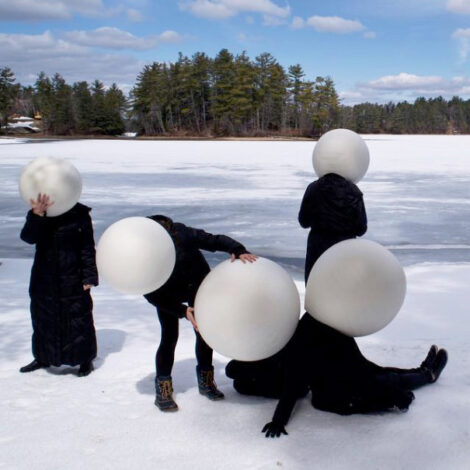
Top Image Credit: Sarah Bouchard, “Orbs at Play”
_____
 RITA LEDUC is an interdisciplinary artist and synesthetic sensor whose creative relationship with ecosystems informs additional relationships on human and societal scales. Recent sites of engagement include Hubbard Brook Experimental Forest (NH), MacLeish Field Station (MA), and Nantucket Harbor (MA). Leduc has taught, shown, and communicated her practice widely, including exhibitions, publications, courses, and events at the Museum of the White Mountains (NH), Syracuse University (NY), The Nature of Cities Festival (Berlin), and Art.Earth’s “Sentient Performativities” (Dartington Hall, UK), among others. Leduc has attended several residencies and received support from entities including NYFA, the Jerome Foundation, Atlas Obscura, Oika, and Rutgers University. She is founder and director of GROUNDWORK and a member of The Place Collective. She teaches in Rutgers University’s interdisciplinary program, Creative Expression and the Environment. Leduc received her MFA from Mason Gross School of the Arts at Rutgers University, Post-Baccalaureate Certificate from the School of the Art Institute of Chicago, BA from the University of Pennsylvania.
 CHRIS BODWITCH has been performing, teaching and choreographing modern, improvisational dance and physical theater for almost 3 decades. Her first creation was Rhombus Dance, a company dedicated to the experimentation of objects, moving bodies and the scientific process. Then, after participating in an intensive performance program at the Dell’ Arte International in Blue Lake, CA, she fell in love with theatrical, european-style clown. She went on to study with Kendall Cornell and joined Clowns ExMachina, an all-women clown troupe in NYC. Currently, she runs a performance and (re)learning lab called Muck and Gold and uses her certification as a Dynamic Emotional Integration Coach to integrate clown, dance and the language of our emotions for healing.